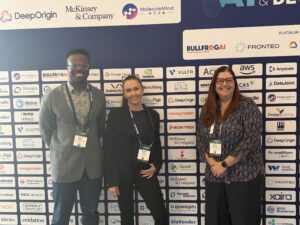
At our AWS Boston Roundtable at Democracy Brewing in Boston on October 15, 2026, the evening’s theme was AI in Life Sciences: What’s Working, What’s Not & What We’ve Learned. Wisdom Akpan, BioTeam Senior Scientific Consultant, was one of our lightning talk speakers, and his talk was titled Attempts at AI-aided Productivity Gains Without Losing My Soul.
In his talk, Wisdom asked what happens to your own expertise as AI takes on more of your work. He then laid out a simple way to decide what to hand to AI, what to keep, and how to stay sharp while doing both.
The usual questions
Most advice on AI delegation comes down to three questions.
- Can AI do it well, or at all? Wisdom adds a second test here: can you tell whether the AI did a good job? If you cannot evaluate the result, you are delegating blind. The same is true when you hand work to a human expert.
- How serious is a mistake? Models make fewer errors with each release. The question is whether you can clean up the mess when one happens, and whether you want to. The more important the task, the more verification it needs.
- Will AI actually save time? Iteration and review can eat up the time saved in production, and some gains do not scale.
These questions focus on the task. Wisdom’s talk focused on what delegation does to the person delegating.
Outputs and expertise
Knowledge workers are responsible for two things. The first is output: the services and deliverables they produce. The second is expertise: their understanding of the products, customers, organization, and domain, which is how they know the outputs are good.
People build expertise by producing outputs, or by learning from others who have. Wisdom frames this as the gap between things you can do and things you know how to do. AI increases what you can do by default. It does not necessarily increase what you know how to do.
That makes AI a double-edged sword. Low-stakes work is where cheap practice happens. Even if you follow standard advice and give agents only the “right” work (gains that scale, actions you can reverse, errors you can inspect), your expertise can stagnate or atrophy if you never engage critically with that work yourself.
Grow, maintain, or offload
Wisdom’s heuristic sorts each task by the kind of skill it exercises, then sets how much AI gets to do.
Grow skills are ones you cannot yet do without AI, and Wisdom protects them aggressively. Do the work without AI first. Use AI only as a coach: it points out problems, and you fix them. Get feedback from real people too.
Maintain skills are ones you already have, and he protects them selectively. Handle the core of the task and let AI fill in. When AI produces something, make it yours by understanding it, and do the task without AI now and then to confirm you still can.
Offload tasks are ones you can delegate freely and without guilt. AI produces the work and you check the result. Some of these tasks can be fully automated, and some can go to another person.
To decide which bucket a task belongs in, Wisdom asks:
- Do I need or want to learn this? Do I find purpose or identity in being able to do it?
- Is this the skill I would use to catch the agent’s mistakes, or to take over when it fails?
- Where in this task does the learning actually happen?
- Am I handing off the expert part of my work or the inexpert part?
- Can I already do it without AI? If not, it is a Grow skill. If so, it is a Maintain skill.
What it looks like in practice
Wisdom applied the heuristic to everyday tasks in three areas BioTeam works in.
Life science research
Grow: When Wisdom needs literature support for a gene or pathway claim, AI suggests search terms and gathers candidate papers. He reads the abstracts and results himself, opens every link, and checks each citation to confirm it exists and says what the AI claims. AI and human experts then test his claims.
Maintain: When an agent builds a pipeline for a familiar data type, he writes the feature spec and points it to existing code and best practices. After the build, he asks AI for a step-by-step walkthrough and notes what would break if he skipped each step. To check an analysis for errors, he runs his own sanity checklist first (sample swaps, batch effects, genome build, plausibility) and then asks AI for extra checks. On the first Tuesday of each month, he does an analysis without AI.
Offload: AI styles his plots, converts formats, and writes ID-mapping code. He checks that the plots render correctly, the new format works as expected, and the mapping rate looks sane.
Scientific IT
Grow: To adopt a new filesystem, scheduler, or auth stack, he reads the vendor docs and has AI quiz him and explain concepts. He drafts the design and runbook himself and tests in a lab environment.
Maintain: An agent drafts his Ansible, Terraform, or Spack recipes. He reads the –check –diff or plan output before reworking and applying them.
Offload: He hands Grafana visualization tweaks to AI with a prompt and confirms the results look as expected.
Software engineering
Grow: When he designs a new feature outside his wheelhouse, he sketches it first, then has AI critique it as a staff engineer would, looking at failure modes, scaling, and simpler alternatives.
Maintain: When he debugs a production incident, he forms a hypothesis from the logs before asking AI. AI lists options and explains unfamiliar errors. He chooses the fix, and the agent can write it.
Offload: AI writes his boilerplate, CI config, Dockerfiles, docstrings, and mechanical refactors. He confirms the code builds and the test suites run.
Learning does not have to slow you down
Protecting your skills can sound like giving up the speed AI offers. Wisdom suggested a few habits that keep you learning without adding much time:
- Predict the result before you prompt.
- Ask the AI to quiz you while it works.
- Ask for options before you ask for outputs.
- Ask, “What do I need to understand to solve this?”
- Park your whys and come back to understand them later.
What organizations should change
Wisdom acknowledged that better models could make parts of this approach moot. For now, organizations still need human expertise to gather and use, and keeping it alive takes effort at the organizational level:
- Delegate to people as well as agents. Expertise stays in an organization when people keep doing the work and teaching it to each other.
- Measure more than output. Track workers’ skills, progression, agency, and ability to stay in control when working with agents, along with how much work gets done and what the AI subscription costs.
- Reward coaching-style use of AI. When teams use AI as a coach or coworker, skill retention does not depend on each person’s discipline alone.
BioTeam works with life sciences organizations on AI readiness, scientific IT, and research computing. To talk through how your team is putting AI to work, visit bioteam.net.