What We Heard on AI in Pharma
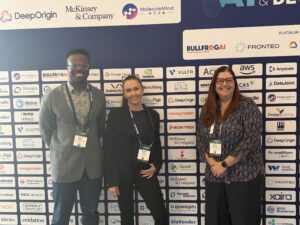
BioTeam’s Michelle Bayly, Wisdom Akpan, and Jennifer Wortman attended the AI Drug Discovery and Development Summit (AIDDD 2026) from October 27 to 29 in Boston. One theme came up on stage and in the hallways more than any other: nobody has yet figured out how to integrate AI across a pharma business in a way that gets more drugs approved and made. Here’s what they heard.
Discovery moved faster than validation
AI has made clear progress in finding candidates. Teams can now generate and rank leads faster than they can test them. Confirming that a candidate works still runs through assays, animal studies, and clinical trials, and AI has done little so far to speed that work up.
The result is an uneven pipeline. A discovery group that doubles its candidate output gains little if validation capacity stays flat. The more useful question now is throughput across the whole path, from target to approval.
Semantics is still the hard data problem
Data semantics remains unsolved. Pharma companies hold years of experimental and clinical data recorded under different vocabularies and naming conventions. Any model built on that data inherits every inconsistency in it.
Big pharma attendees were also openly skeptical of all-in-one data platforms as the fix. That matches what we see in our FAIR data and AI readiness work. A new platform moves the data, and the semantic mismatches move with it. Agreed vocabularies, governed metadata, and clear ownership of each data domain do more of the work than the platform underneath.
Vendors still have a messaging problem
AI vendor messaging has not kept pace with the engineering. At least one vendor introduced a new feature as a “swarm.” For scientists and IT leaders already cautious about autonomous systems touching regulated data, a name like that raises concerns before the demo starts.
Pharma buyers want to know what a tool does, what data it touches, how it is validated, and who answers for it when it is wrong. Vendors who answer those questions up front will have an easier time with these buyers.
Where AI could get more creative
The most promising technical thread was progress in abductive reasoning and probabilistic programming. Abductive reasoning works backward from an observation to its most plausible explanation, which is close to how scientists form hypotheses. Probabilistic programming lets a model represent uncertainty directly, so it can report how confident it is and why.
Together, these point toward AI that helps scientists propose new ideas, a step beyond ranking and filtering what is already known. They also bring new demands. Probabilistic methods can be expensive to run, and they depend on well-characterized data, which loops back to the semantics problem above.
On the panel: what comes after discovery
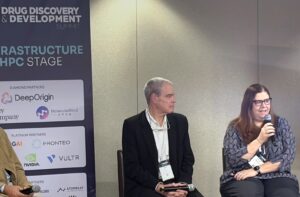
Jennifer Wortman, BioTeam’s President and Managing Director, joined the panel “What Comes After Discovery? Extending Scientific Compute Strategy Across Development and Operations.” The topic lines up with the gap described above. Most scientific compute and data strategies were built for discovery, and they often stop where development and operations begin.
What this means for R&D IT
The hardest problems we heard about sit between the models: the handoff from discovery to validation, the vocabularies that connect one dataset to another, and the trust between vendors and the scientists using their tools. These are infrastructure and organizational problems as much as AI problems.
BioTeam works on these questions with pharma, biotech, academic medical centers, and federal research institutions. If your team is sorting through any of them, we would be glad to talk.
Let us know if you have a question or want to talk: info@bioteam.net