
Built by Scientists, for Scientists
As life science organizations race to unlock the promise of AI, many are discovering a difficult reality: their data isn’t ready. Research data is often fragmented across labs, instruments, departments, cloud environments, and external collaborators. Valuable scientific context becomes trapped in spreadsheets, disconnected databases, and ad hoc workflows. Even organizations investing heavily in AI frequently struggle to provide researchers with trusted, discoverable, and reusable data. To address this challenge, BioTeam scientists and engineers have developed Delfini, a next-generation platform designed specifically to help life science organizations transform disconnected research data into an AI-ready asset.
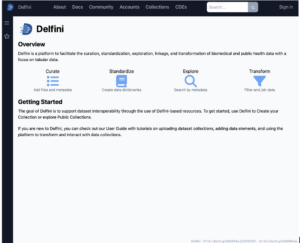
Delfini’s intuitive onboarding experience helps researchers quickly begin exploring datasets, metadata, and available resources.
BioTeam’s Karl Gutwin explains why:
“Over the years working with a variety of clients, we’ve seen one consistent challenge with data management tooling. Most data management platforms have either originated outside of scientific fields, meaning that they require a lot of additional engineering to work with scientific data, or else they are purpose-built for specific scientific data types, making them challenging to extend at best or inflexible at worst. Delfini was designed to meet the needs of scientists who want to be able to create, store, share, and reuse their data without relying on incomplete documentation or needing to personally know the colleague who created the original data.”
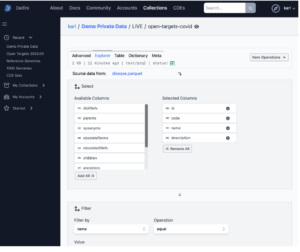
Researchers can browse and discover available datasets through Delfini’s Explorer interface while maintaining appropriate governance and access controls.
Making Metadata a First-Class Scientific Asset
One of Delfini’s foundational principles is that metadata should be treated as a critical scientific resource rather than an afterthought. In many environments, valuable context is lost as data moves between systems. Researchers often spend significant time understanding where data originated, how it was processed, and whether it can be trusted for downstream analysis.
Delfini addresses this challenge through two approaches.
First, Delfini leverages the concept of data elements, a rich column-level metadata standard that captures experimental context and intent in a consistent form that is reusable and machine-readable for AI tooling.
Second, Delfini automatically preserves metadata and data lineage throughout the data lifecycle as data is loaded, transformed, and shared. This allows researchers to maintain traceability while creating datasets that remain understandable, reusable, and ready for future analysis.

Common Data Elements provide a standardized framework for describing scientific information, improving discoverability, interoperability, and reuse across projects and organizations.
Live Data Transformation Without Data Duplication
Scientific organizations frequently struggle with data harmonization. Different groups use different naming conventions, formats, standards, and governance requirements. Traditionally, organizations solve this by creating additional copies of data and performing extensive ETL processes.
Delfini introduces a different model.
Using dynamic dataviews, organizations can transform, harmonize, filter, and redact information in real time without repeatedly duplicating datasets. Researchers gain access to analysis-ready information while organizations maintain control over governance and compliance requirements. The result is a more agile approach to data management that reduces operational complexity and accelerates scientific workflows.
Enabling Secure Scientific Collaboration
Scientific discovery increasingly depends on collaboration. Research institutions work with industry partners. Academic centers share information across departments. Multi-site studies require data exchange between organizations. Yet many data-sharing approaches remain cumbersome, requiring manual transfers, duplicate repositories, and extensive coordination.
Delfini embraces a federated model that enables secure collaboration across distributed environments.
Instead of forcing all participants into a single centralized system, organizations can share data selectively while maintaining local control and governance. This creates new opportunities for collaboration while reducing the friction traditionally associated with scientific data exchange.
Building the Foundation for AI-Ready Research
AI has become one of the most discussed topics in life sciences, but successful AI initiatives depend on far more than models and algorithms. High-quality AI outcomes require trustworthy, well-organized, well-governed data. By focusing on provenance, metadata, harmonization, and collaboration, Delfini helps organizations establish the data foundation necessary for future AI initiatives. Rather than treating AI readiness as a separate project, Delfini embeds those capabilities directly into the scientific data lifecycle. The result is a platform designed not only for today’s research challenges, but also for the next generation of data-driven discovery.

Structured scientific data remains accessible, searchable, and ready for downstream analytics and AI-driven workflows.
From the Field to the Platform
Delfini reflects BioTeam’s longstanding commitment to solving real scientific infrastructure challenges. The platform was developed by scientists and technologists who have spent decades working alongside research organizations, helping them navigate data growth, cloud adoption, HPC modernization, AI initiatives, and large-scale scientific collaboration. That experience shaped every aspect of Delfini’s design. Rather than adapting enterprise data management tools for research, BioTeam built Delfini specifically for the realities of modern science.
Looking Ahead
As research organizations continue to generate larger, more diverse datasets, the need for flexible, scalable, and AI-ready data management will only increase. Delfini represents BioTeam’s vision for how scientific data infrastructure should evolve: preserving scientific context, enabling collaboration, reducing operational burden, and accelerating discovery. The future of research depends on making data more usable, more trustworthy, and more accessible. With Delfini, BioTeam is helping organizations take that next step.
Request Demo Access and Experience Delfini Firsthand
Organizations interested in exploring Delfini can request a personalized demonstration with the scientists and technologists who helped design and build the platform. These sessions focus on real research challenges and workflows rather than generic software features.
Whether your organization is evaluating AI readiness, improving data discoverability, establishing governance practices, supporting data sharing across collaborators, or modernizing research infrastructure, a Delfini demonstration provides an opportunity to see how these capabilities can be applied within your own environment.
During the session, attendees can explore key features, including metadata management, Common Data Elements, dataset discovery, governance controls, and AI-ready data workflows, while discussing their organization’s specific goals and challenges with the BioTeam team.
To request a demonstration, simply click the “Request Demo Access” blue button on the Delfini homepage.
Learn More
To learn more about Delfini or request a demonstration, visit: https://delfini.bio