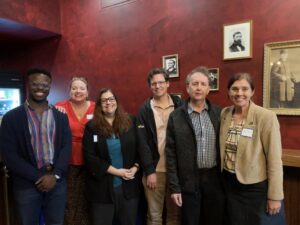

The life sciences industry has spent the last several years getting excited about AI. Now it’s getting specific. Jennifer Wortman, Nick George, Brian Osborne, and Abby Farrar were in New York last week at the AWS Life Sciences Symposium. The conversation had moved on from “should we use AI?” to something harder: how do you build environments where AI can actually participate in the scientific process, from target identification to experimental validation, without falling apart the moment it leaves the proof of concept? That question ran through nearly every session. And the honest answer, across the room, was that most organizations aren’t there yet.
From Disconnected Tools to Integrated Workflows
One of the clearest signals of where this is heading is the recent launch of Amazon Bio Discovery, AWS’s new suite that brings model access, benchmarking, and downstream execution into a single interface. It hosts open-source models like AlphaFold, partners with organizations like CZI, and integrates with CROs so teams can move from target design to experimental testing without bouncing between disconnected systems. The goal is to close the gap between insight and action. That gap is currently very wide.
AI in drug discovery has long operated at a remove from actual experimental work. Models generate outputs, scientists review them, and the loop back into the lab is slow, manual, and lossy. What organizations are now investing in is tighter integration, with AI embedded in experimental workflows rather than adjacent to them.
This reflects a broader realization that models are not the bottleneck. Context is the bottleneck. AI only delivers value when it operates within a real scientific environment. Without the context, even sophisticated models struggle to move beyond theoretical output. The Context problem is underrated
Several organizations at the event shared results from implementations that had moved beyond generic AI deployments. The pattern was consistent; performance improved significantly when teams invested in domain-specific definitions, structured metadata, and clear representations of scientific concepts.
One framing that stuck: organizations succeed when they find ways to show agents what they mean by certain things, rather than assuming the model already knows. It sounds obvious. In practice, it is not what most teams prioritize.
The Production Gap Is Still the Hardest Part
Despite the excitement in the room, the most cited statistic was sobering, with roughly 80% of AI agents failing in production due to fragile pipelines, poor error handling, and limited observability. The gap between what works in a demo and what works at scale is still significant. The takeaway from session after session was that the same reliability has to be designed in from the start, not retrofitted later. Graceful degradation is not optional. Neither is early investment in monitoring and error handling.
Platform Thinking Is the Next Competitive Move
Several large pharma organizations are ahead of this curve in one specific way, they have stopped thinking about individual models and started thinking about platforms. Many have built internal AI platforms that abstract away the underlying model(s) behind a single interface. Researchers and technical users interact with a single system, and what runs in the backend can be swapped out without disruption. The result is centralized governance, consistent logging, and a user experience that does not change whenever a better model is introduced.
It is a shift from model-centric experimentation to system-level design. And for organizations still standing up new workflows for every new model release, it is worth paying attention to.
Foundations Before Ambition
The symposium closed with a slide that deserved more wall space: “Data foundations before agent ambitions. Agents are only as good as the data they see. “There was broad agreement in the room, and broad acknowledgment that it is easier said than executed. The organizations making real progress are not the ones who moved fastest to adopt new tools. They are the ones who invested in the foundations that make those tools work: clean data, domain context, and infrastructure built for reliability.
At BioTeam, this is the work we do every day, helping organizations move from fragmented AI experiments to production-ready scientific systems. Data foundations, lab, and compute workflow integration, infrastructure designed to hold up in the real world.
If you are working through similar challenges, we would love to connect
 .
.
Photos taken at AWS Life Sciences Symposium, April 2026, NYC.