
Summary
A leading biotech organization needed a secure, modern, and automated scientific computing foundation to support high-throughput therapeutic discovery for neurodegenerative and lysosomal storage diseases. The client relied on a fragile single-account AWS setup, costly storage, and inefficient use of HPC and licensed applications. These limitations slowed researchers, wasted expensive software licenses, and created compliance risks.
Bioteam helped to modernize its research environment with the following activities:
- Migrated from a single AWS account to a secure, governed multi-account AWS organization
- Deployed ZFS storage for microscopy data
- Automated HPC environment provisioning and integrated license-aware scheduling for scientific software
- Established consistent research environments by building automated CI/CD pipelines for golden images and robust testing across environments
Our solutions reduced manual overhead, eliminated delays, improved compliance readiness, lowered infrastructure costs, and accelerated their ability to bring therapies from research to development. Researchers now access HPC resources on demand and work in reproducible environments. The organization can scale research operations confidently while accelerating time to therapeutic discovery.
Challenge
The client faced difficulty expanding research infrastructure as scientific demands grew. Use of a single AWS account increased compliance risk and complicated governance. Effective management became labor-intensive. Researchers spent too much time waiting for high-performance computing (HPC) resources. The inefficiency hindered their ability to make discoveries and advance their work.
The high-resolution microscopy data exceeded the capacity of their current storage solutions, resulting in increased costs and reliability concerns. Researchers couldn’t efficiently run scientific applications like Schrödinger and Relion, resulting in underutilization of expensive licenses and idling of resources. Development environments were inconsistent and difficult to reproduce, leading to delays and errors in scientific workflows.
The organization needed a secure, cost-effective, and automated foundation that could keep pace with ambitious therapeutic discovery goals while ensuring audit readiness and reducing time to results.
Approach
BioTeam delivered a comprehensive modernization initiative:
- Cloud Foundation: Migrated the organization to a multi-account AWS Organization with strong guardrails and SCPs to support regulatory compliance and audit readiness.
- Data Infrastructure: Deployed local ZFS-based NAS storage to cost-effectively capture and serve microscopy data, avoiding the expense of proprietary solutions.
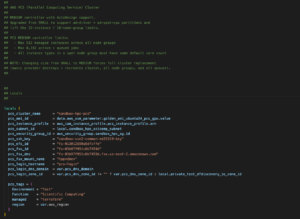
- HPC Automation: Automated HPC cluster rapid spin-up. Enabled on-demand scalability for resource-hungry workloads.
- Application Integration: Automated builds and license-aware job scheduling for complex scientific tools such as Schrödinger and Relion. Ensured efficient resource utilization and researcher productivity.
- Development Lifecycle Automation: Created Continuous Integration / Continuous Deployment (CI/CD) pipelines to:
- Build reliable “golden images”
- Matrix test across multiple instance types
- Ensure workflow reproducibility and environment consistency
- Infrastructure as Code: Produced reusable, automated workflows for development lifecycle environment deployment without lock-in, ensuring flexibility and long-term maintainability.
Outcomes
BioTeam reduced compliance risk by replacing a fragile single-account AWS setup with a secure, governed multi-account structure. Researchers gained faster access to HPC resources through automation, reducing setup times to minutes and eliminating manual configuration delays.
We lowered data storage costs by deploying a reliable ZFS-based NAS for microscopy workloads. License-aware scheduling maximized the use of expensive scientific software licenses, reducing waste and enhancing productivity.
We provided consistent development lifecycle environments through automated CI/CD pipelines that delivered golden images and aggressive, proactive matrix testing. We reduced errors and delays in research workflows. Overall, the client expedited discovery, improved cost efficiency, and enhanced their ability to scale therapeutic research securely.